Buying note · 11 October 2026 · revised 15 October 2026
Which revision, and should you buy one at all.
The short answer
Same processor platform, same shell shape, same controls, same finish list — one shell is used for all three boards. V12 cannot take our WiFi module at all, so a V12 connects through the USB dongle. V21 and V30 both take it as an option.
An earlier version of this page, and of our own shop, said V21 and V30 came in four finishes each. That was wrong: all fifteen finishes can be built on any of the three boards, and the shop now lists them that way. The correction is ours to make.
A shell color is not proof of the board inside, and neither is a marketplace listing that says "V12". The revision is printed on the board itself: our sample boards read R36S-V21 2024-12-18 and R36S-V30 2025-11-18.
And the honest part, which costs us sales: do not buy one if you want PSP, N64, DS, Saturn, PS2 or GameCube to run well, if you expect phone-style standby, if you need guaranteed save files, if you want games and a memory card in the box, or if you need a certified non-clone guarantee. That list is longer than the sales copy you will read elsewhere, and it is the point of this page.
1. The questions buyers actually ask
Three questions come up again and again from people buying their first handheld. What can I get for around 500 yuan? Is a vertical handheld the right shape for me? And the one that decides everything here: is there anything to watch out for with this R36S?
The fourth is the one I hear from people who bought without asking first. They picked up an R36MAX2 as a first handheld because the screen is bigger and it cost a hundred more, and they are not sure it was the right call. That is the decision this page is about, and the honest answer is that the bigger screen is not the thing that should have decided it.
And the reputation is genuinely two-sided. I sell this handheld, so I am going to put the negative side down too. On the positive side: for this class of device an R36S is all you need, and for GBA it is enough. On the negative side: there is a pile of promotion around it, video platforms are full of R36S tips that are really advertising, there are so many of them it feels risky, and save files get lost — that one I hear often enough to treat it as real. I have also had a V12 with WiFi noise reported back to me.
Both halves are true. It is a cheap, repairable, well-documented 4:3 handheld, and it is a device with an enormous amount of affiliate content around it, reports of lost save files, and a speaker hum on WiFi builds. Each of those is addressed below, including the ones we cannot explain.
2. Why the version confusion exists
The revision names come from the board, not from a shop and not from a marketing plan. They are supplier board revisions, silkscreened on the PCB next to a date.
Sellers list the color, and buyers read the revision into it — wrongly. Every finish is built on every board, so a color carries no information about the revision at all. "I bought the purple one" tells you nothing certain about the board.
The revision matters for one practical reason: firmware and the device tree. Community firmware images ship with multiple device trees, and picking the one that matches your board is the step that goes wrong. That is why the revision number is all over the community conversation — it is a software-pairing question far more often than a hardware-quality one. We wrote about that separately in our note on device trees and black screens.
3. What actually differs
The finish list does not differ between boards. All fifteen finishes in this shop can be ordered on V12, V21 and V30 — a finish is a shell, and the three boards share the shell. A table of finishes against revisions would now be fifteen ticks in every column, which is why the matrix that used to sit here has gone.
One per-finish restriction is real. The supplier cannot fit the vibration module to Transparent Pink. That finish is orderable on any board, without vibration; the other thirteen take the module.
If you want the WiFi module, you want V21 or V30 — and read the disclosure before you decide you want it. WiFi builds have a faint speaker hum; our own product page states this before purchase, and the report quoted above is somebody noticing the same thing on their own unit. Disabling USB or network settings may require reflashing to get WiFi back. That is not a scare line; it is a recovery limitation we would rather tell you about than have you discover. A USB WiFi dongle and adapter is available for any revision, including V12, which sidesteps both. We have since gone looking for a mechanism behind that recovery limitation and wrote up what we found on a V30 — including a repeatable way to lose Wi-Fi for about thirty seconds without changing any setting at all. It is not a fix for the limitation, and we say there what we have not verified.
⚠️ Unresolved: we have a report of a V12 developing WiFi noise. In our own catalogue, the WiFi module is not offered on V12 at all — so that unit was either using a dongle, or came from a batch we do not source. We are not going to explain it away; we simply do not know which.
4. What does not differ
This matters more than the revision list, because it is what people actually want to know. The boards in our photographs carry a Rockchip RK3326, on both the V21 and the V30 sample. The form factor is the same across revisions: a portrait 3.5-inch 4:3 screen, a D-pad, four face buttons, two analog sticks, four shoulder buttons and two card slots. And no revision is a performance upgrade — if a listing implies that V30 is "faster", that is not a difference you can buy. Between the three revisions, the finishes are the same; the WiFi module option is not.
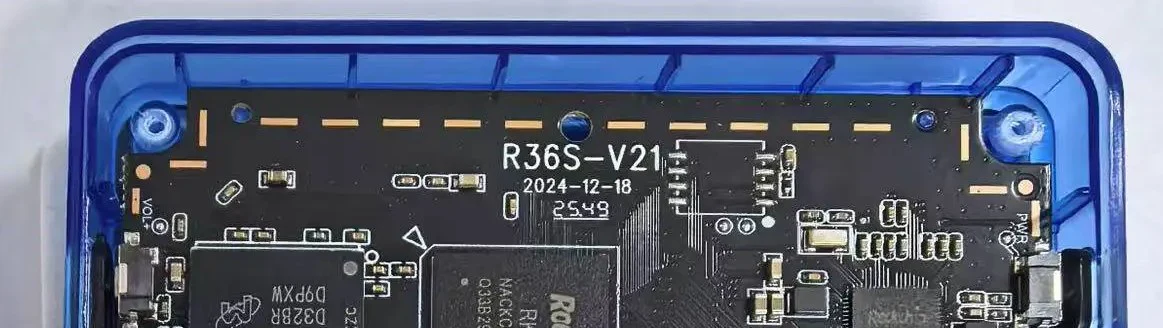
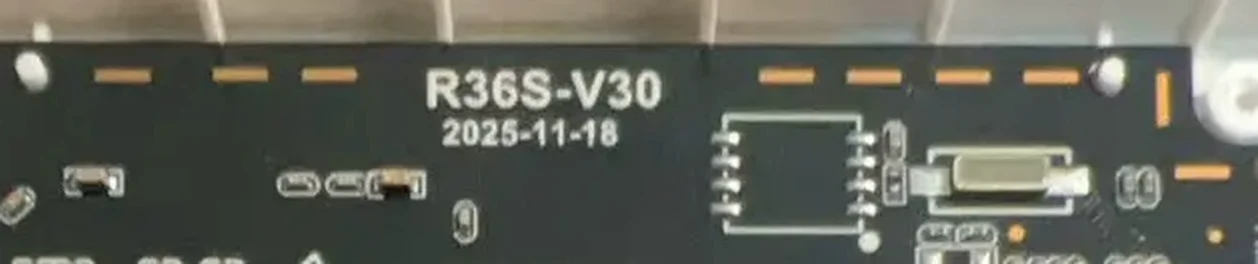
On memory, the specification is 1 GB and the usable reading on a real unit is 897 MiB. We have two readings of it and they were taken from different places: reading the running system directly reports 897 MiB of total memory, and the vendor System Info screen on the unit we photographed reports Total: 895 MB. A machine sold as 1 GB with roughly 896 MB visible to the operating system, the remainder reserved by the vendor kernel, is what this is — and the two readings sitting 2 MB apart is a difference between two measurement surfaces, which we are reporting rather than ironing out.
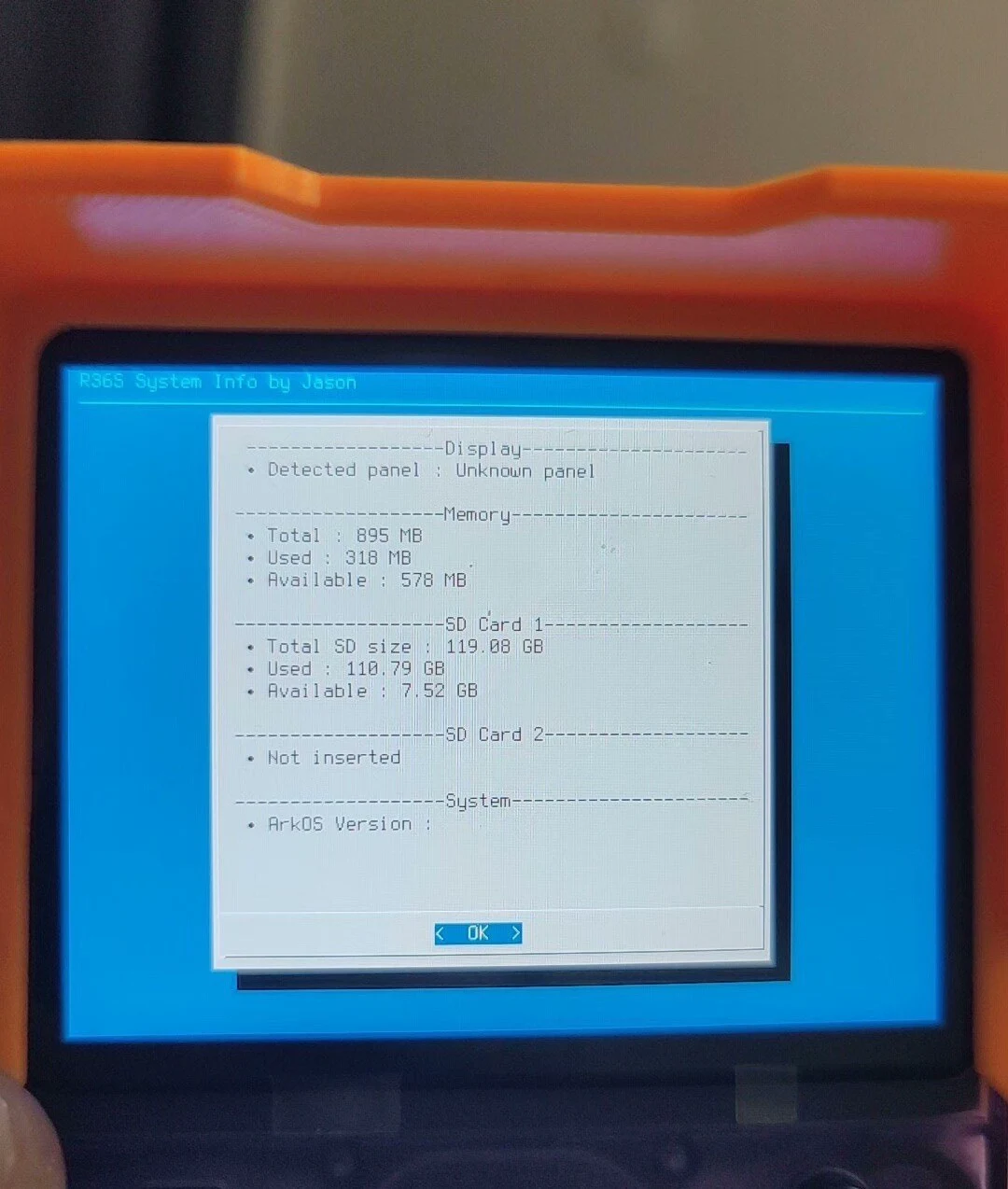
⚠️ Not verified: we did not verify how the memory reservation is accounted for, and we did not reconcile the 2 MB between the two readings — we report what each surface said. The ArkOS version row on that screen is blank on that build, and we are not going to fill in a version number we did not read.
5. How to choose
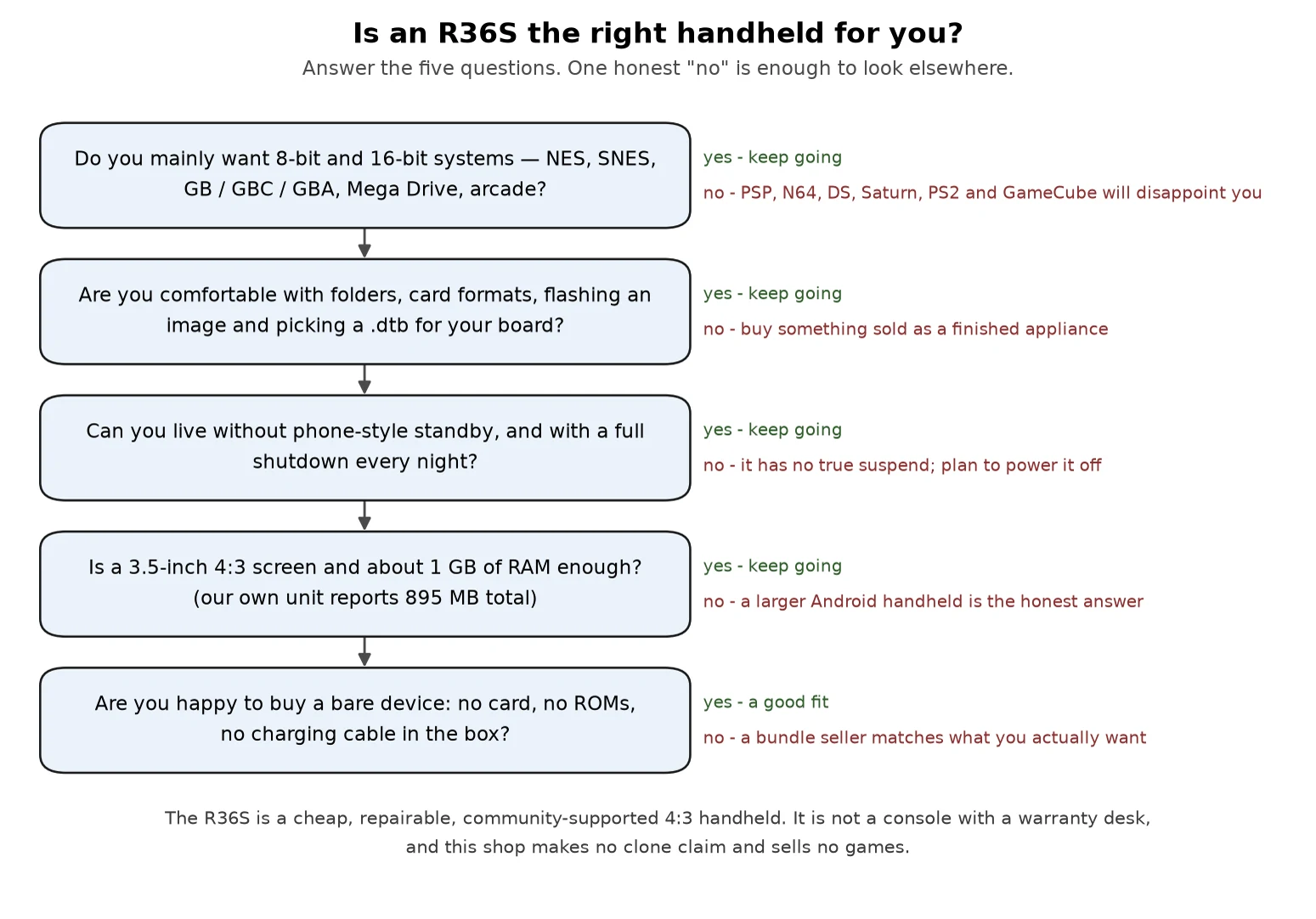
Decide the revision by what you cannot live without. The WiFi module means V21 or V30. If WiFi is not something you want, the three boards are otherwise the same choice, so it comes down to finish and price — and every finish is open to all three.
Decide whether you want WiFi at all. It brings a faint speaker hum and a recovery limitation. If you only want to play, skipping it removes a whole category of annoyance.
Choose the finish you will still like in a year. Transparent shells show dust; solid shells hide the internals that make this thing fun to own. That is taste, not performance.
Decide where the games come from, before you pay. A bare handheld ships with no games, no memory card and no charging cable. If "it just works out of the box with games on it" is your requirement, a bare device is the wrong purchase — and so is this shop. The mechanics of adding your own games are in our note on games that never show up.
Write the configuration into the order. Board revision, finish, WiFi or not, dongle or not — in writing, before payment. "Left" and "V30-ish" are not order specifications.
6. How to verify what you actually received
Read the board. With the back shell off, the silkscreen gives the revision and a date: R36S-V12, R36S-V21, R36S-V30. This is the only method we treat as conclusive, and it is why we publish board photographs.
Check the WiFi option. If the WiFi module was part of the deal, confirm it exists on the unit you were sent.
Read the system information screen. Our own units carry a vendor page with display, memory, card and system blocks. Useful — with one caveat.
Do not trust the color. Every finish exists on all three revisions, so the color tells you nothing about the board.
Photograph what arrived before you open anything, and keep the packing. It makes any conversation trivially easy.
⚠️ Honest limitation on the software route: a running system reports the device tree it booted, not necessarily the board it is sitting on. If a previous owner flashed a V21 device tree onto a V30 board, a software check will happily report V21. We therefore do not publish a "type this command to learn your revision" recipe as a verified method — the silkscreen is the method we stand behind.
7. Who should not buy an R36S
This section costs us money. It is also the only section most buyers actually need.
Do not buy it if you want to play PSP, N64, DS, Saturn, PS2, Dreamcast or GameCube. The RK3326 is a four-core Cortex-A35 class chip with a Mali-G31-class GPU and about 1 GB of RAM. 8-bit and 16-bit systems are what this machine is for; PS1 generally runs well on this chip class; anything above that is a compromise you will notice in the first hour. We publish no frame-rate benchmarks — treat that as a boundary we are drawing, not a measurement we took. Buyers reach the same conclusion in their own words: a dedicated machine can be specially optimised, while an R36-series handheld is at best a pile of emulators bundled together. I am asked regularly why the PSP emulator is missing and why the Saturn emulator does not work.
Do not buy it if you want a device that behaves like a phone. There is no phone-style standby. You shut it down, or you find it flat. We wrote about that in the charging and battery note.
Do not buy it if losing a save file would ruin your week. Lost saves are reported often, and the way owners report them is the part that sticks with me: stated flatly, as if losing an evening of progress were unremarkable. That is their framing, not ours. We have no verified root cause to give you.
⚠️ Not reproduced: we have not reproduced a lost save, so we cannot tell you the cause. What we can tell you is what reduces exposure: save in-game and use a save state, exit games through the emulator's own quit path rather than switching the unit off, never remove the card while the system is running, and keep a copy of your saves on a computer. None of that is a guarantee.
That stance has not changed, and it is worth saying so here rather than burying it: we still have no root cause. What we have since written is a longer piece on lost saves — three separate faults that all get reported with the same sentence, how to work out which one you have, and why backing up your games folder is not backing up your saves. Read it if this caveat is the one that worries you; it will not give you a fix, because there is not one to give.
Do not buy it if you need a memory card, a charging cable or games in the box. Our listings are bare by design: no card, no ROM library, no charging cable. No copyrighted ROMs are sold, here or anywhere legitimate.
Do not buy it if "is it a genuine, non-clone unit?" is a question you need answered with a certificate. Our position is stated on our own product page: board photographs show what is visible on those samples, and a photograph of one sample does not certify every shipped batch, and we do not make a clone claim. If a seller tells you a photo proves authenticity, they are overselling it.
Do not buy it if the lowest possible price is your only criterion. In the domestic Chinese market these have been seen around ¥260 with a card bundled, second-hand units move for less, and the cheapest US listing we recorded in our own market research was $52 — below our own starting price, though we did not verify what that listing actually includes. If price is the whole decision, shop those instead: that is a legitimate choice, and this shop is not the answer to it. What a shop like ours charges for is a stated configuration in writing, disclosed tradeoffs, a bare unit with no bundled ROMs, and a 7-day change-of-mind return with direct support. If that is not worth anything to you, it is not worth anything to you.
Do not buy it if you want an OLED screen, HDMI out, a bigger panel or modern 3D. None of that is what this is.
8. Price: what the numbers actually are
A bare V12 in this shop is $57.90 delivered to the United States, with tracked shipping and import duty already inside that figure; the V21 is $58.90 and the V30 $59.90. Hardware add-ons cost extra and are priced, with the delivery window, in writing. We recorded an R36S with a 128 GB card and games at $79.99 on a public US marketplace listing, and the cheapest R36S listing we recorded at $52.00, transparent purple, with no bundle stated — we did not verify what that listing includes, nor whether its price included shipping. Domestically, a card-bundled unit has been reported around ¥260.
Read that honestly and it says: a bare R36S at $57.90 delivered is not automatically the cheapest R36S. We recorded a $52 listing and a $79.99 card-and-games bundle in the same market, and domestically these go for far less. What you are choosing is a bare device with a stated configuration and disclosed tradeoffs, versus a bundle whose card, card quality and ROM contents you did not choose. Both are legitimate purchases. Do not let any shop — including us — tell you the second option does not exist.
9. How not to get burned
Ask these five questions, in writing, before paying. The answers are cheap; discovering them afterwards is not.
Which board revision, exactly? V12, V21 or V30, in the order record. WiFi module, or not? And if yes: is the speaker hum disclosed, and are you told that network settings may need a reflash to recover? What is delivered, and what does it cost delivered? Item, shipping, and who pays import charges. What is the return window, and who pays return postage? How do I get help when it goes wrong? A named channel, not "contact us".
Then apply the same scrutiny to any review you read. A useful video measures something — runtime, temperature, frame rates — shows a drawback, or opens the shell. A video that only unboxes it and calls it good value is an advert, whether or not it is labelled as one. That criticism is fair, it applies to this product more than to most, and the correct response is not to argue with it but to be the exception.
Our own version of that scrutiny: the five things to check before buying a bare R36S, how shipping and import costs are quoted, and our returns policy.
What we measured, and what we did not
From our own catalogue data: that every finish is offered on every board, and that the WiFi module is a V21 and V30 option while the dongle is available for all. From our own board photographs: the V21 and V30 silkscreen markings with their dates, and that both boards carry a Rockchip RK3326. From our own photograph of a real unit: the vendor System Info screen reading 895 MB of total memory, against 897 MiB read from the running system — a 1 GB specification with about 896 MB usable. From our own published price list: the delivered figure for each board revision, with add-ons and the delivery window quoted in writing. From our own market-research records: the $79.99 card-and-games listing and the $52.00 cheapest listing — and we did not verify what that $52 listing includes.
Not verified by us: the roughly ¥260 domestic bundled price, which is a buyer report; the lost save files, for which we have no root cause and say so; the V12-with-WiFi-noise report, which we cannot reconcile with our own catalogue and leave unresolved; any claim that a software check can identify the board, which we do not publish as verified; and anything about PSP, N64 or PS2 performance, which we state as a limitation rather than a benchmark. We claim no frame rates.
The flowchart is a drawn diagram, not an image model's illustration. The photographs are real photographs of supplier sample boards and of a real unit's screen, cropped and downscaled only. No price, version number, part number, command or file path in this article is invented.
We sell this handheld. The "who should not buy one" section is deliberately the longest honest list we could write, because a buyer who arrives informed does not ask for a refund.
Related reading
Black screen after flashing — the practical consequence of the revision you chose.
The charging light and the battery — the WiFi tradeoffs and the standby behavior, in full.
Inside an R36S — board photographs at full size: the V12 and V30 silkscreen, the memory packages, and what is behind the back cover.
Configure a bare R36S, the first steps guide, the shop FAQ, and contact.