OPENED UP
Inside an R36S.
Seven photographs of an R36S with the back shell off: the board markings that identify a revision, the memory packages, the vent in the back cover, and the cooling stack.
They were taken by hand in October 2026 and published unretouched, with the long side capped at 1600 pixels and the camera’s metadata stripped. Nothing is cropped.
Each caption describes what is in its own frame, or in the frame beside it, and stops there. Where a part was added by hand rather than fitted at the factory, the caption says so.
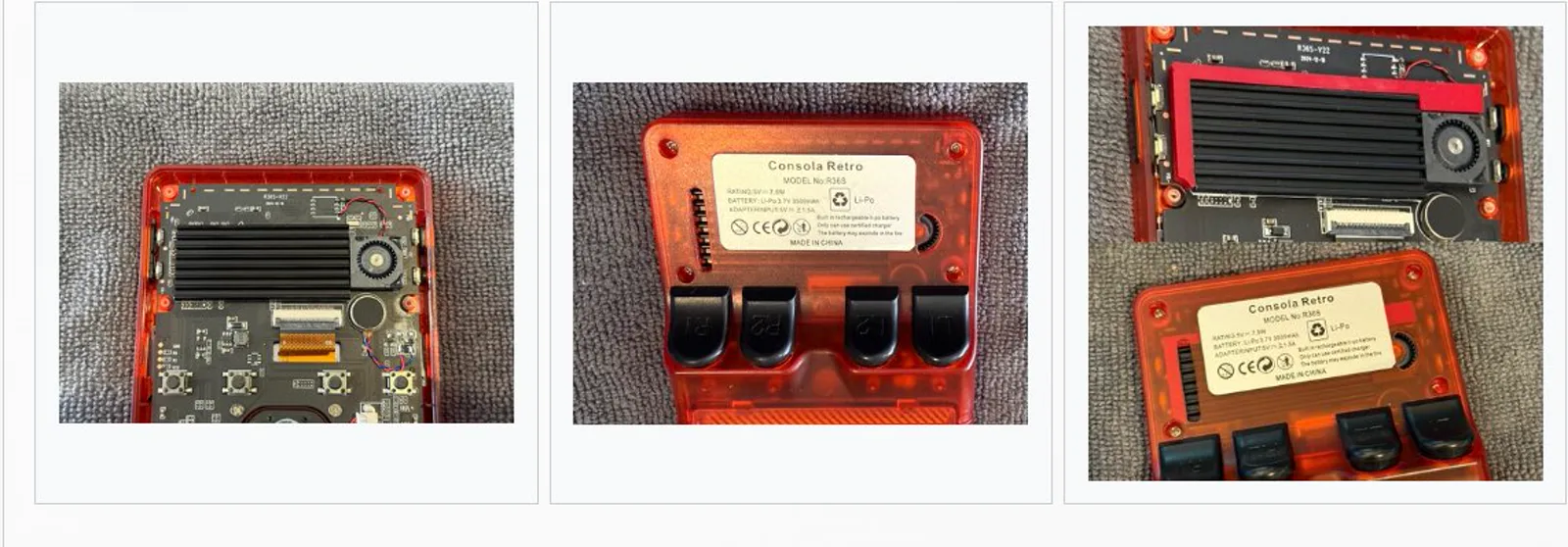
The cooling stack, three frames in oneA cooling modification on our own transparent red V12 unit, three frames combined into one image. A black finned heat spreader runs across the board with a small round fan mounted at its right end to move air through the shell. The middle frame turns the cover over: the battery label is legible as Consola Retro, MODEL No. R36S, BATTERY Li-Po 3.7V 2500mAh, with the four shoulder actuators beside it. Transparent red is one of the fifteen finishes and is sold on V12. The 2500mAh figure is what the label in the frame reads; it is not a capacity we state elsewhere, and we have not measured it.
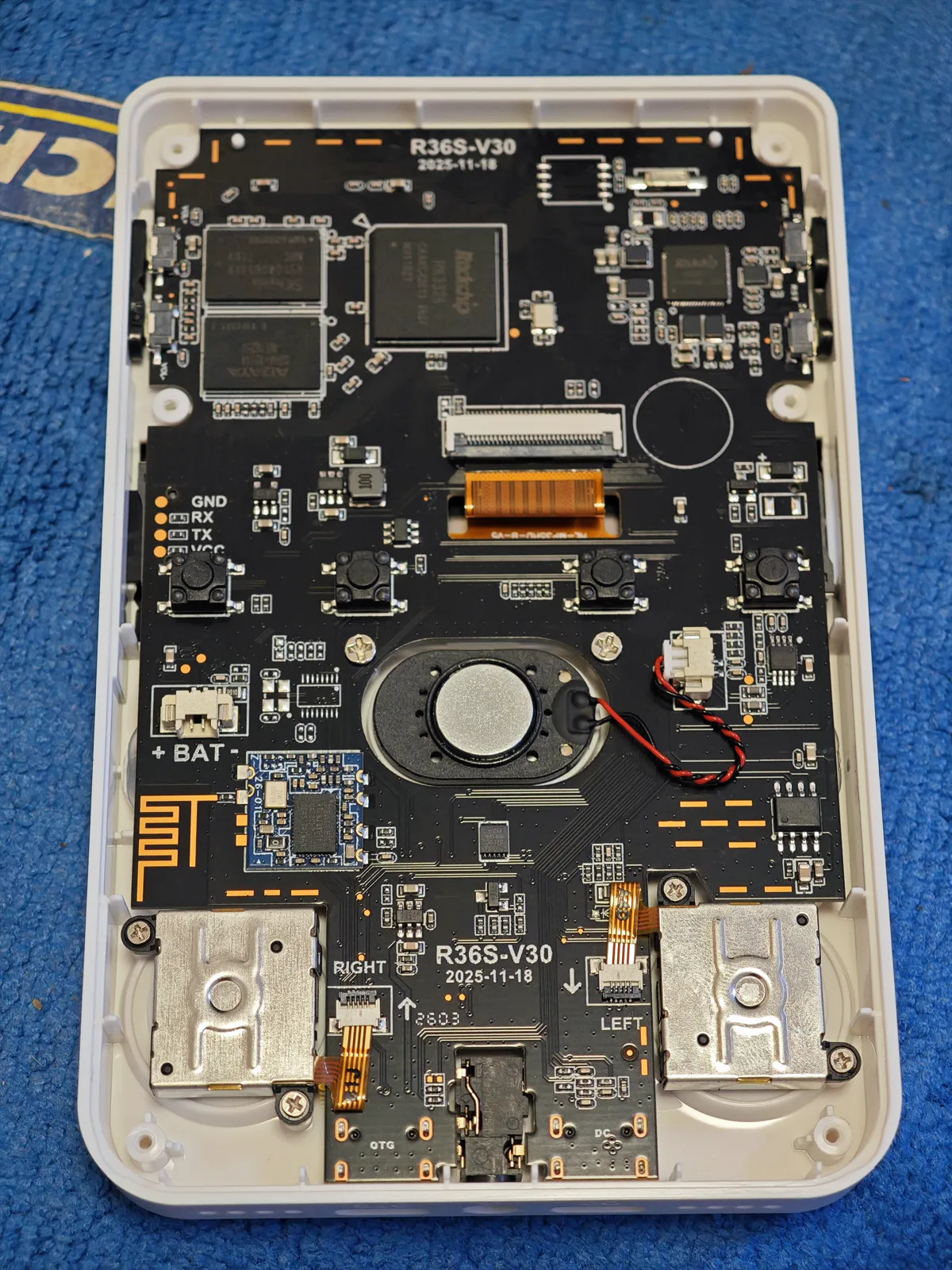
V30 board, shell offA white unit with the back shell off. The silkscreen reads R36S-V30 and 2025-11-18 twice: along the top edge and again between the shoulder mounts, with RIGHT and LEFT printed beside those mounts and OTG and DC along the bottom edge. GND, RX, TX and VCC are labelled at mid-left, next to a + BAT marking at the battery connector. Two memory packages sit at the top left beside the Rockchip module, the round speaker and its twisted two-wire lead sit in the middle of the board, and a gold finned heat spreader covers the right-hand side. 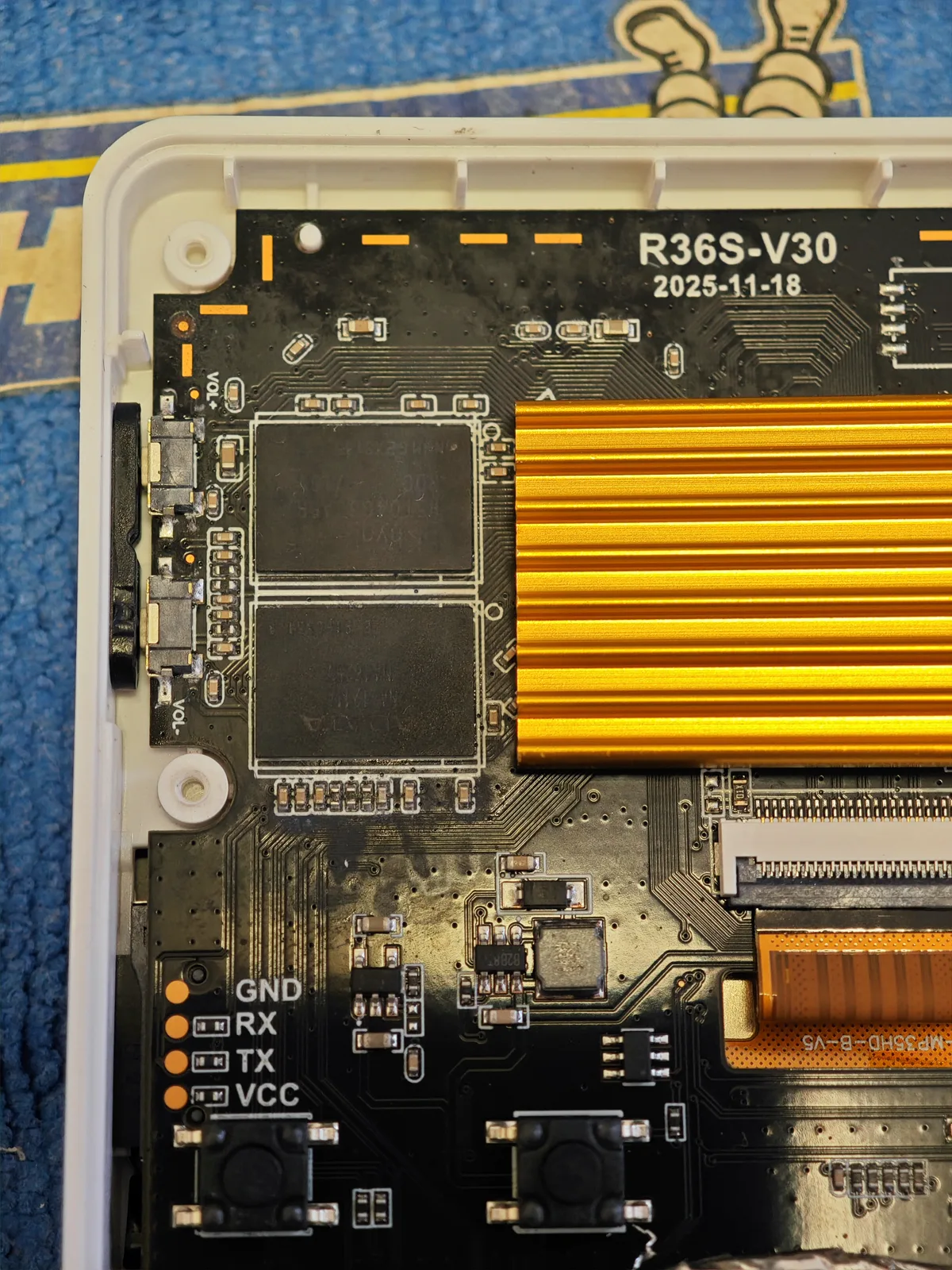
Two memory packages, closer inThe same V30 board, framed on the two packages and the gold heat spreader beside them, with the R36S-V30 marking and its date in the top right of the frame. This is the photograph that shows two packages, and that is all it shows. One frame of two packages is not a measurement of how much memory the board carries, so this page prints no capacity next to it. 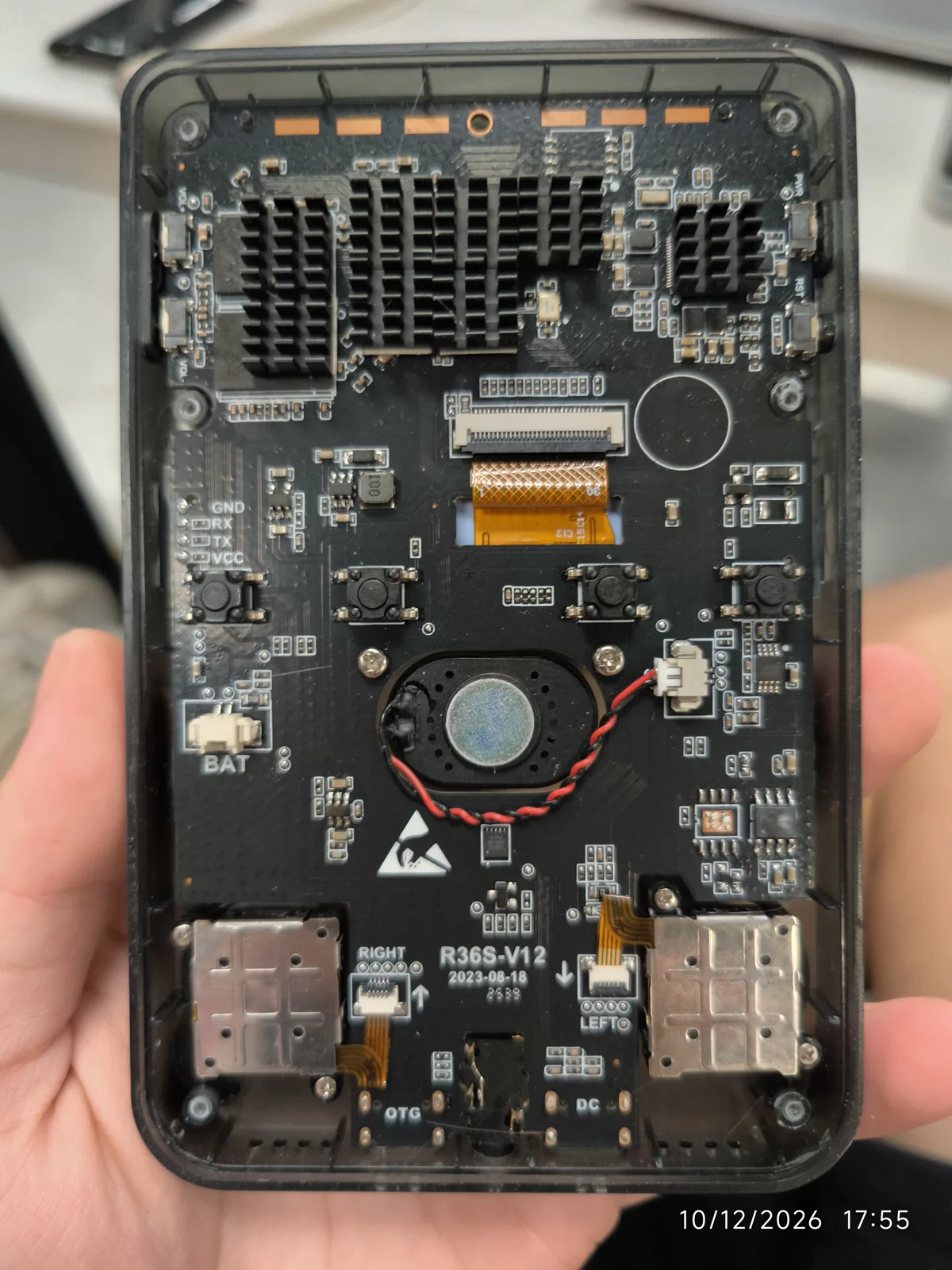
V12 board, dated 2023The oldest of the three revisions, held in the hand. The date burned into the bottom right of the frame, 10/12/2026, is the camera's, not the board's. The silkscreen prints R36S-V12 and 2023-08-18 in the same position the V30 uses, with 2603 below it, RIGHT and LEFT beside the shoulder mounts, and OTG and DC along the bottom edge. Where the V30 photograph shows one gold heat spreader, this board carries two black finned ones. Same layout family, two years apart, in a black shell — which is the point: the shell is not the revision. 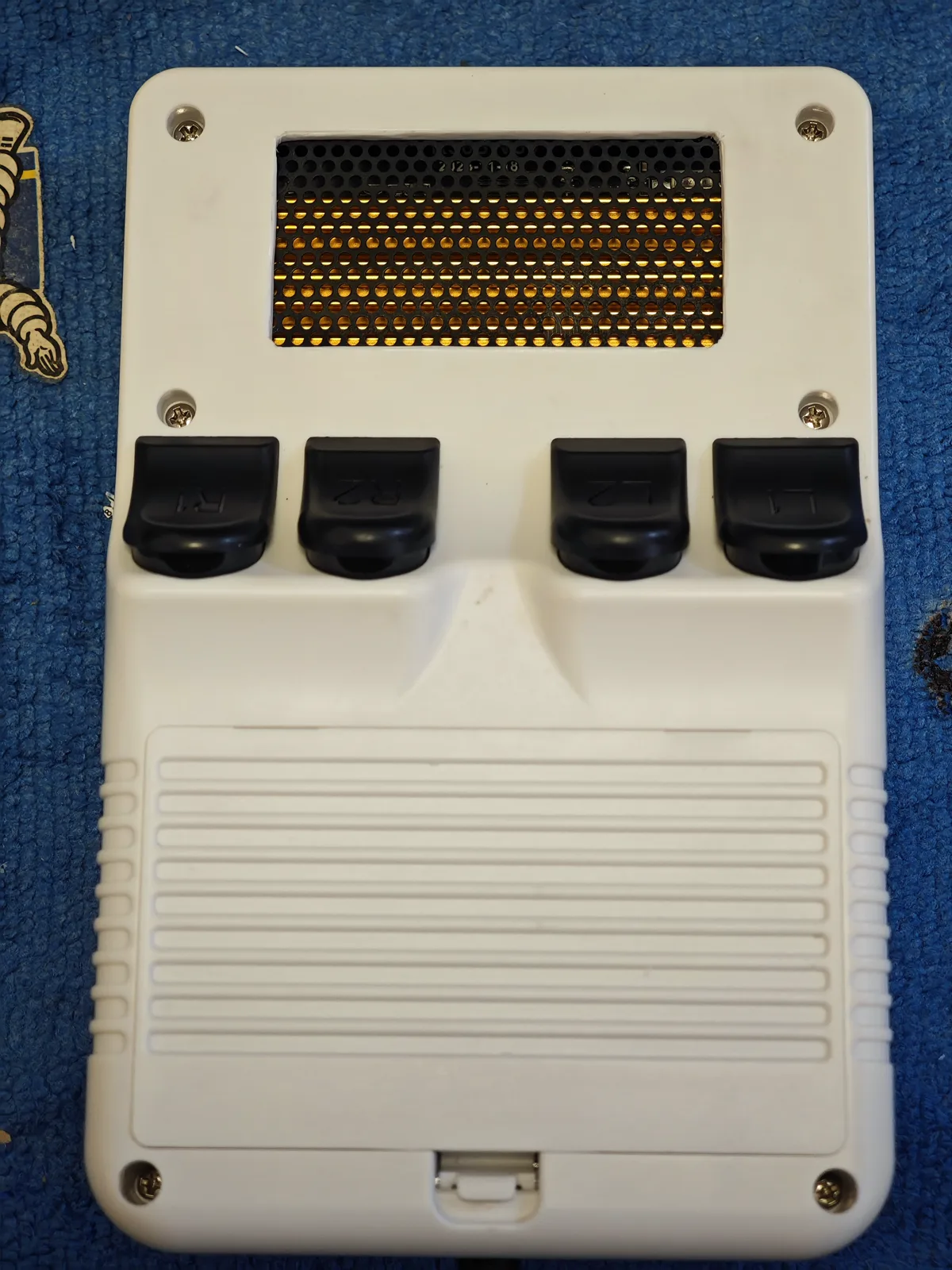
The back cover, opened outThe white back cover from the outside — the same cover as the frame below it. A rectangular opening was cut in the shell above the shoulder buttons, and a black perforated sheet sits in that opening; a gold honeycomb surface shows through it from the board behind. Below the opening are the four shoulder buttons, each carrying a moulded marking, and the ribbed grip runs down the rest of the cover. This shell is screwed together. The opening is a modification we made; it is not how the cover arrives. 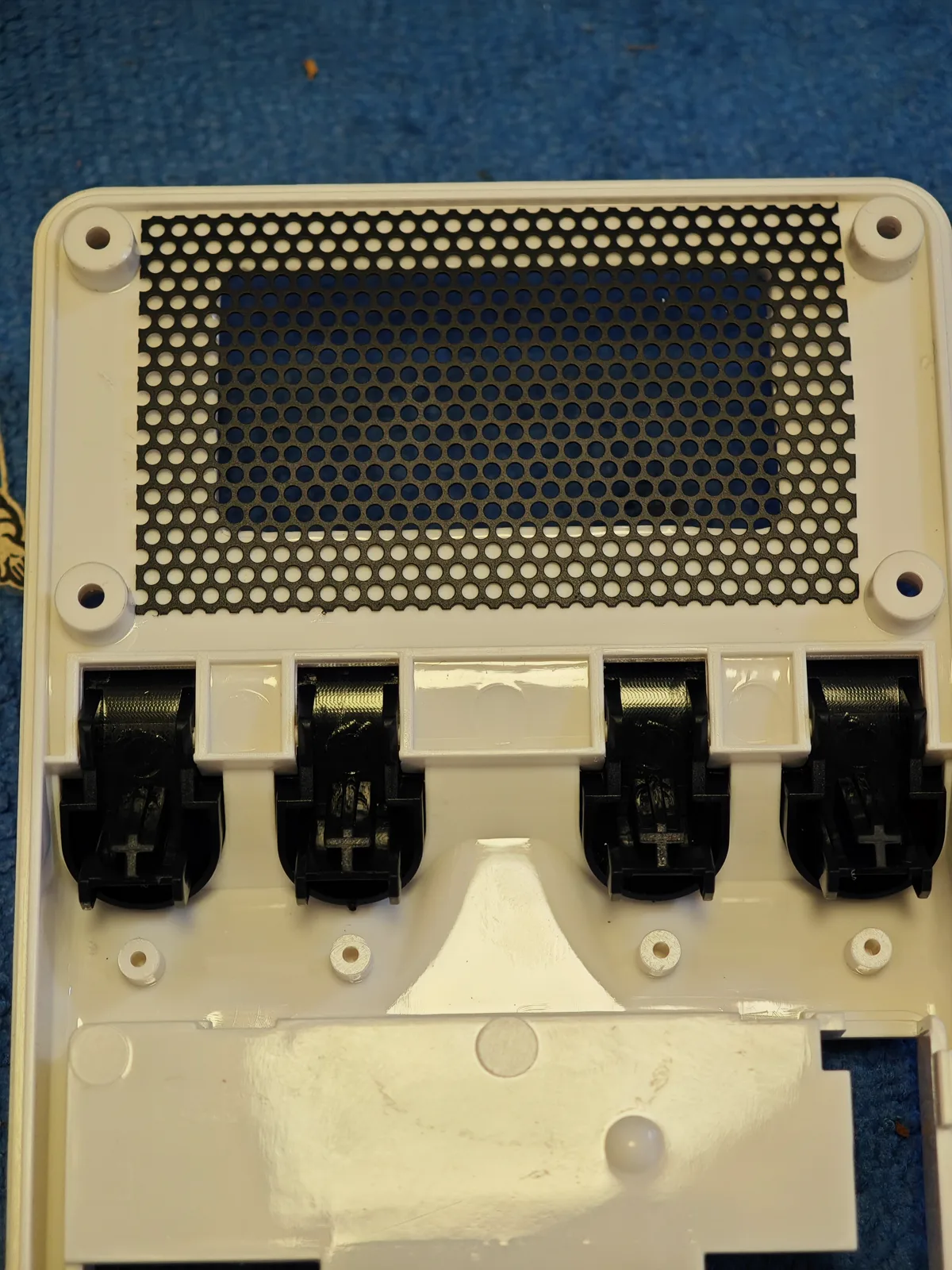
Mesh, from the insideThe same cover, turned over: the inside of the opening cut in the frame above. We cut that opening so air could move across the board, and fitted the black mesh across it to keep dust out — which is why the plastic around the edge carries hand-tool marks. Below the mesh the four shoulder actuators sit in their moulded housings on metal springs. How much dust the mesh actually stops is not something we have measured, so this frame shows the layer rather than rating it. 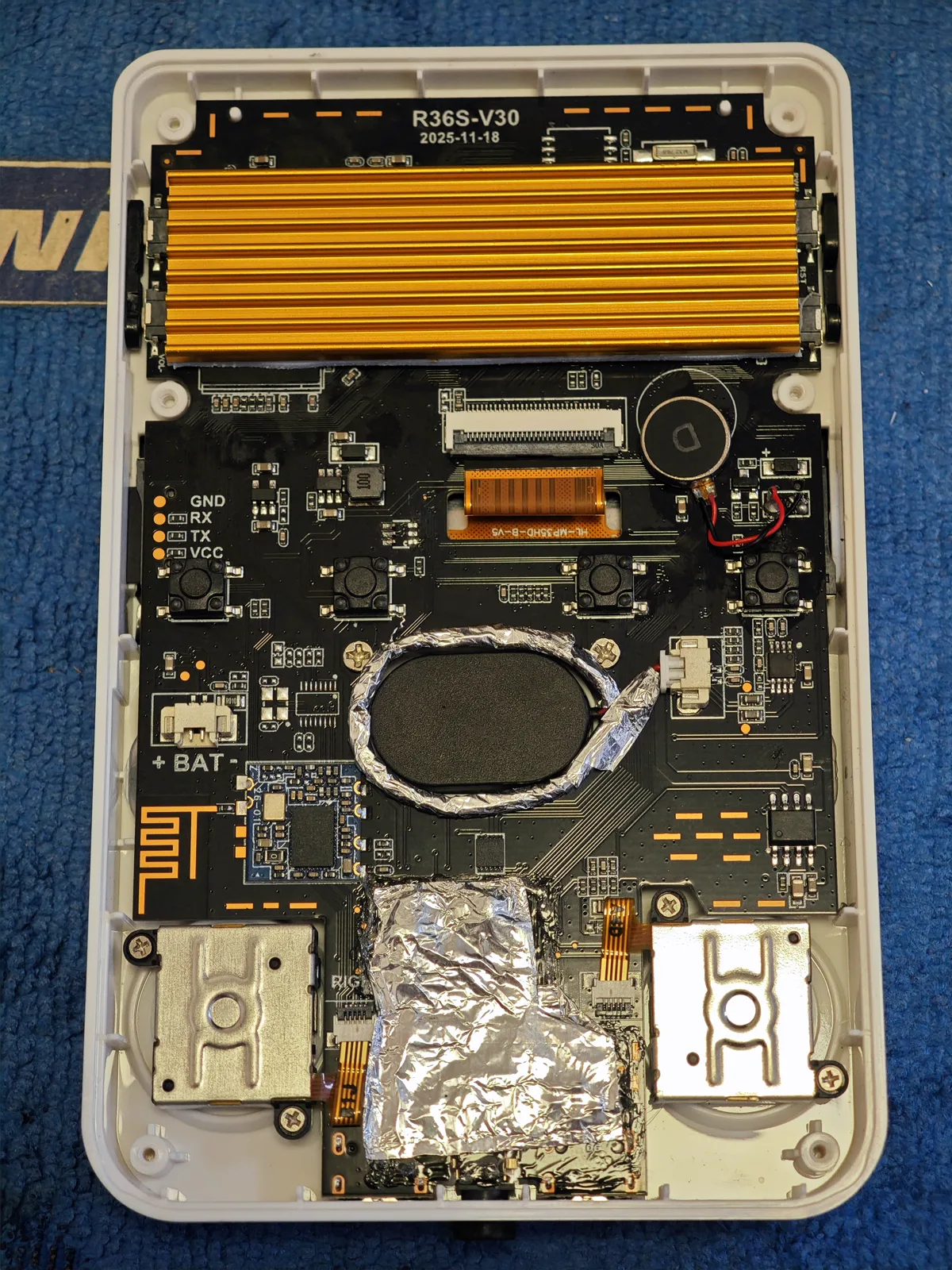
Foil tape, added by handNot a stock part. The owner wrapped the round speaker in aluminum tape and laid a second patch over the board below it. It is on this page because it is what was actually done to this unit, not because it is fitted to the units we send: the WiFi builds are the ones with the faint speaker hum our product page discloses, and this was one owner's attempt at it. Nothing here is measured and we make no claim that it worked.
Why we publish these
Because the two questions that decide whether you are buying the handheld you think you are buying cannot be answered from a product photograph. The first is which board revision is inside: V12, V21 and V30 take different firmware, and no shell color tells you which one you have. The second is what the board actually looks like when somebody opens it, so you have something to compare against when your own unit arrives.
So we show the silkscreen rather than describe it. R36S-V12 and 2023-08-18 on one board, R36S-V30 and 2025-11-18 printed twice on another, both in the same position between the shoulder mounts. That marking is the only revision check we stand behind, and it is why the guide tells you to open the shell rather than run a command.
The cooling photographs are here for a plainer reason: nothing else on this site claims anything about how the unit is cooled, and a buyer asking whether the back cover is vented deserves a picture instead of a promise.
What these photographs do not show
A capacity. One frame of two memory packages is a count, not a measurement. We do not print how much memory the board has, and we do not claim a number for it, because we have not established one by a method we would stand behind.
A batch. These are individual units, photographed one at a time. One board with a V30 marking is evidence about that board and not about a production run.
An authenticity test. A two-package layout is a two-package layout. It is not a test for anything, and we publish no method that claims to be one.
A stock part. Three of these frames show work done by hand on the unit that was photographed, not parts that come from the supplier: the opening cut in the back cover and the mesh fitted across it, and the foil tape over the speaker. The captions say so frame by frame. We make no claim that any of them is fitted to the units we send, and we publish no measurement of how much any of them changes the temperature.
Related reading
V12, V21, V30: which revision — what actually differs between them, and who should not buy one at all.
Black screen after flashing — why the board revision changes which device tree you need.