Field note · 15 October 2026
What games can it run?
The short answer
8-bit and 16-bit consoles and handhelds, and the arcade boards of that era — that is what this machine is for. PlayStation 1 generally runs well on this chip class. Above that, you are in a band where a game being playable depends on the game, and getting further out than that is not a matter of configuring anything.
The part worth reading the whole page for is the middle. “It runs PSP” and “it does not run PSP” can both be said honestly by two people holding the same handheld, because one of them has an emulator installed and the other does not, and neither of them is talking about the chip.
1. The question as it actually arrives
Every version of this question we found in a corpus of roughly 7,500 messages from public Chinese-language handheld groups looks the same way: a specific game, a specific failure, and no idea which layer is at fault.
From 开源掌机中文社区⑤群: “why can’t the patched ROMs I downloaded be played on the handheld? I went through every core and none of them worked.” That is one sentence containing a fault, a failed remedy and an assumption — the assumption being that the core was the thing to change.
From r36s(开源掌机)交流1群, separately: “why is there no PSP emulator on mine?” — not “PSP is too slow”, but “it is not here”. And from 安伯尼克掌机交流群, about a different system: “guess why the Saturn emulator doesn’t work.” Two more from the same corpus, on systems further out: “the 3DS emulator has problems”, and “emulators still struggle to fully emulate the Switch” — a sentence that is true of every handheld in this class and every desktop, and is not about this device at all.
Two more, because they are the pieces of the puzzle that are not about the chip. From R36S掌机爱好者: “the handheld doesn’t have enough memory, it keeps flashing” — a capability complaint. And from r36s(开源掌机)交流1群, about a game rather than a system: “does anyone know why this game displays so small? The menu has nothing to adjust it either.” That one is a setting, not a ceiling, and it is the reason this page sorts failures before listing bands.
2. Four tiers, not a list of games
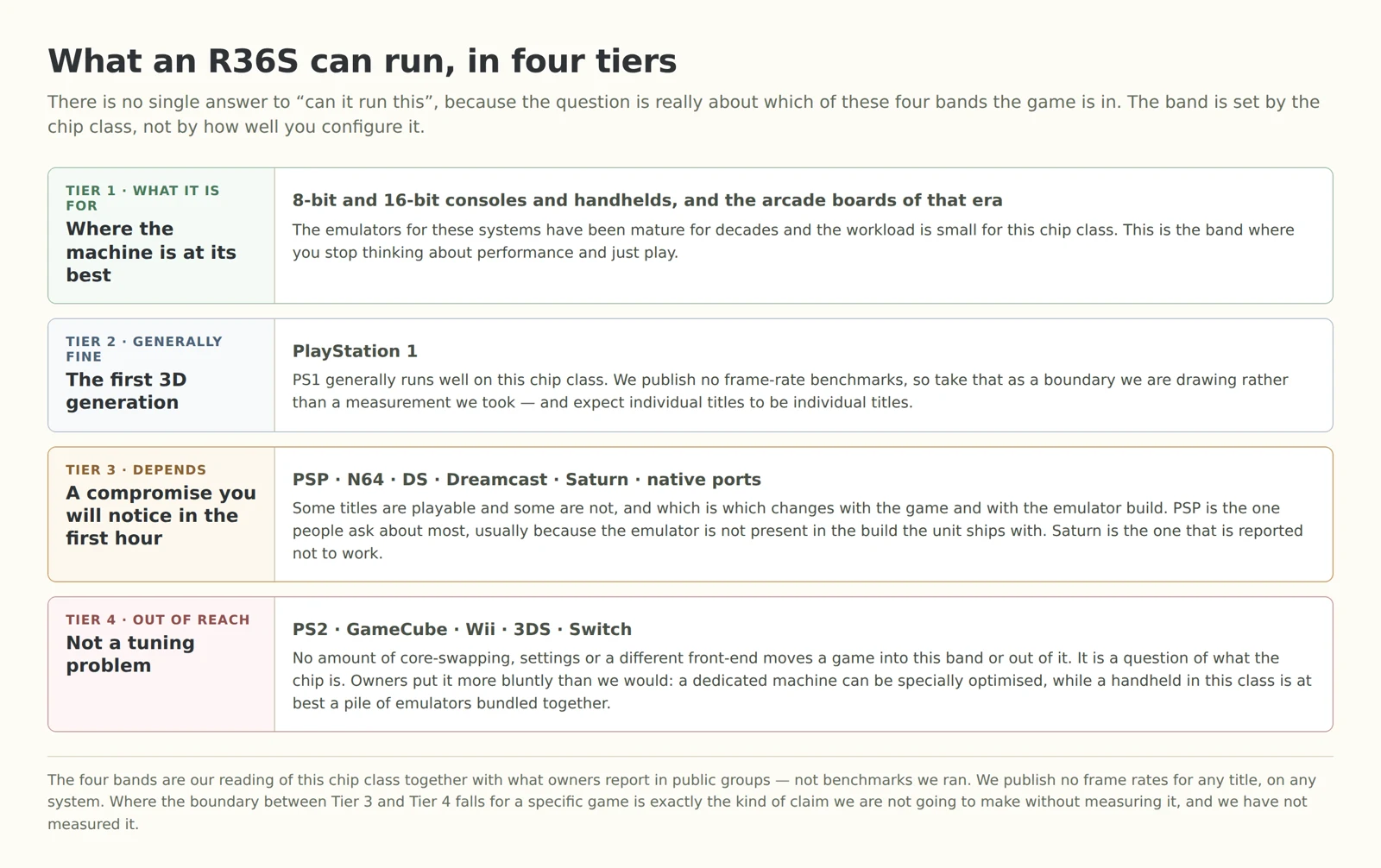
We are not publishing a compatibility list. A list of titles with marks next to them is the format this question arrives in and it is also the format we cannot fill in honestly: we have not run these titles, and a list implies a measurement that does not exist.
What we can do is say where each band starts and why, and be clear that the tier 3 boundary — “a compromise you will notice in the first hour” — is the site’s own phrasing, taken from the buying page, where the same line is drawn to answer a different question: whether to buy one at all. That page tells you what to buy it for. This page tells you why the line is where it is.
⚠️ Our reading, not a benchmark: the four bands are a reading of this chip class together with what owners report. We publish no frame rates for any title on any system, and we have not measured where the tier 3 boundary falls for a specific game. If you need a number, this page is the wrong page and we would rather say so than invent one.
3. “I tried every core and it still won’t run”
This is the most useful thing on the page, because it takes the corpus’s most common complaint and explains why the remedy in it could not have worked.
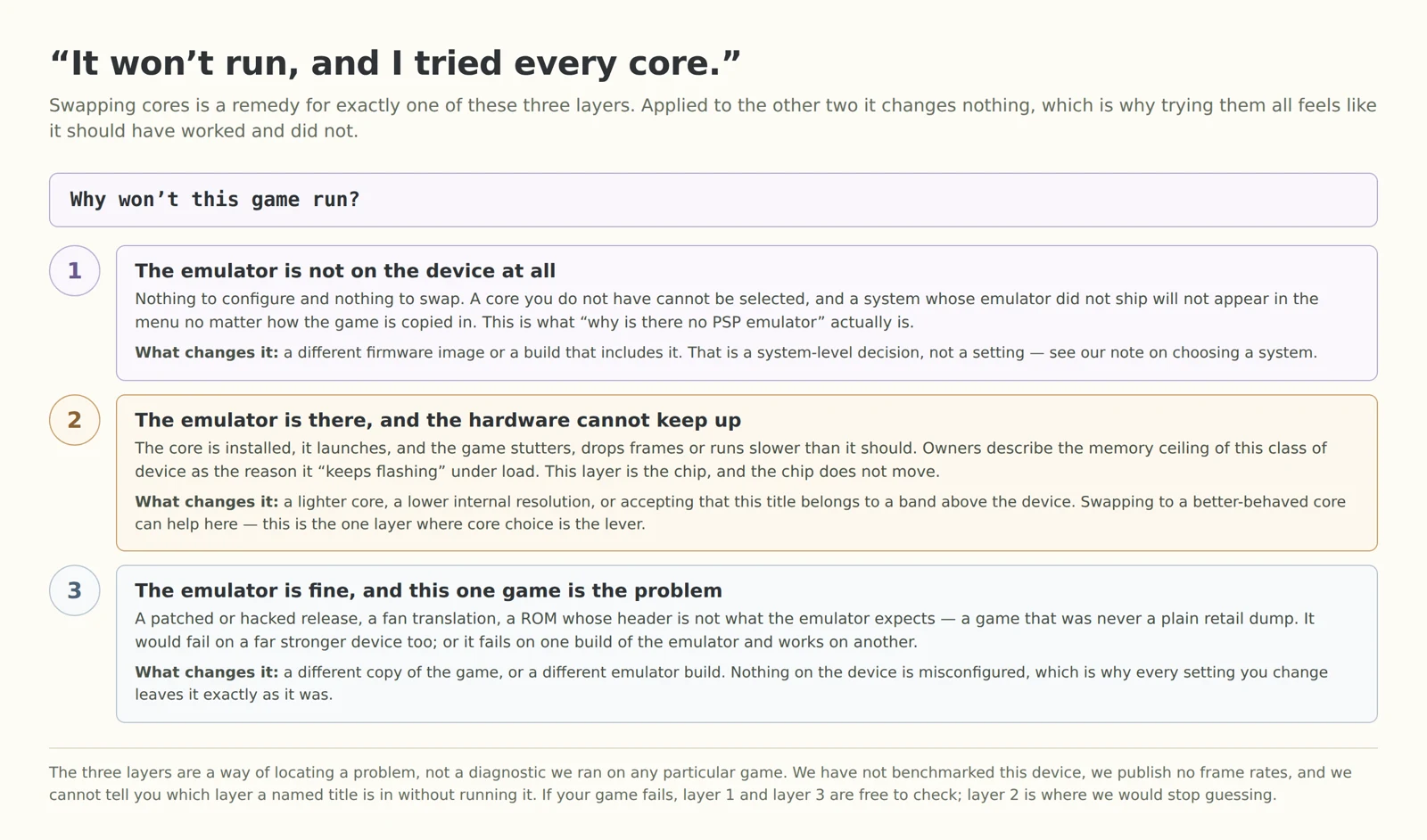
The emulator is not on the device. Nothing to configure and nothing to swap. A core you do not have cannot be selected, and a system whose emulator did not ship will not appear in the menu however carefully the game was copied in. This is what “why is there no PSP emulator” actually is, and the answer is a system-level decision rather than a setting — which is the subject of our note on choosing a system.
The emulator is there and the chip cannot keep up. The core is installed, it launches, and the game stutters or runs below the speed it should. Owners describe the memory ceiling of this class of device as the reason it “keeps flashing” under load. This layer is the hardware, and the hardware does not move: swapping to a lighter core can help here, and it is the one layer where core choice is the actual lever.
The emulator and the chip are both fine and this one game is the problem. A patched or hacked release, a fan translation, a file whose header is not what the emulator expects — a game that was never a plain retail dump. It would fail on a far stronger device too. Nothing on your handheld is misconfigured, which is precisely why every setting you change leaves it exactly as it was.
⚠️ A way to locate, not a diagnostic: these three layers come from how emulation is put together, not from tests we ran on this device. We cannot tell you which layer a named title is in without running it, and we have not. Layers one and three cost nothing to check; layer two is where we would stop guessing.
4. Two of the three things people call “a game” are not emulation
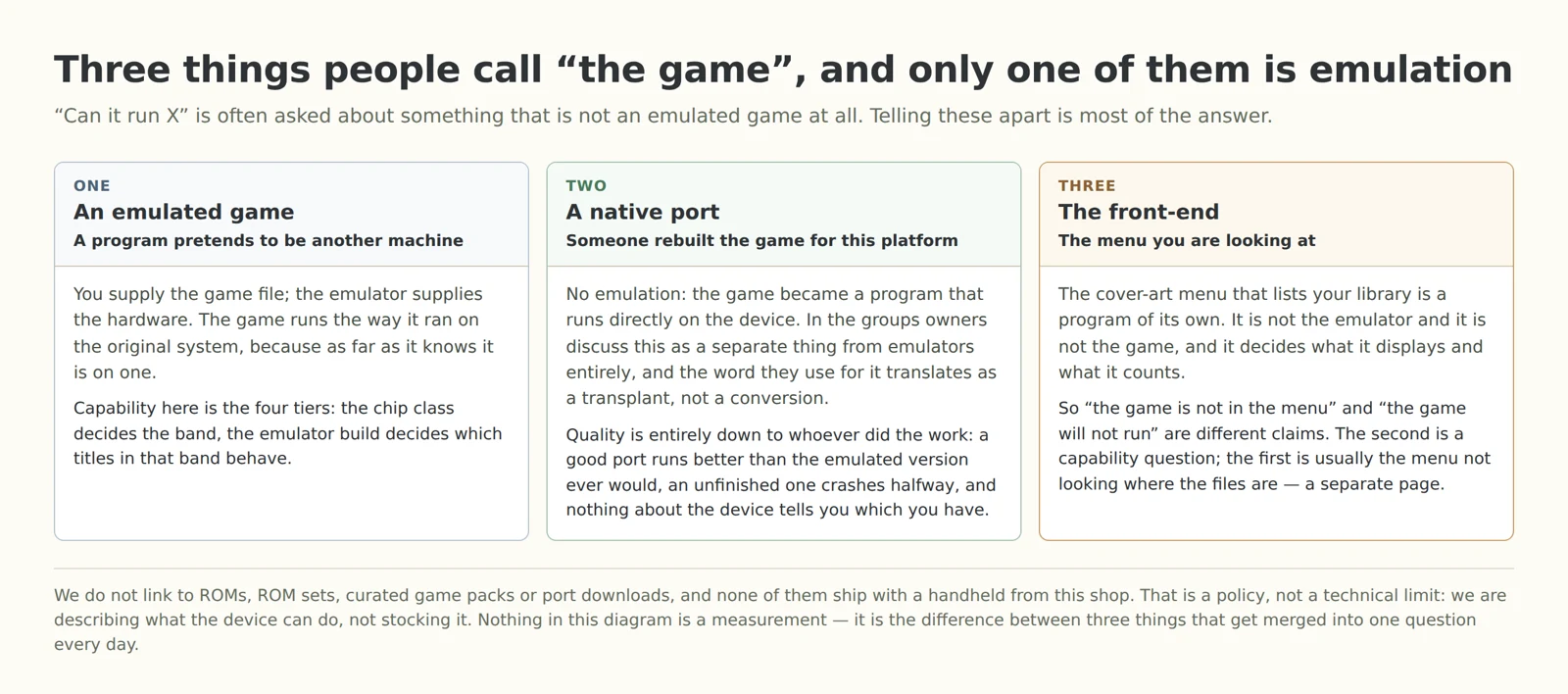
In the groups, ports are discussed as a separate thing from emulators, and the word owners use for them translates as a transplant rather than a conversion. A good port runs better than the emulated version of the same game ever would; an unfinished one crashes halfway through; and nothing about the handheld tells you which of those you have. That is why “can it run” is the wrong question for a port — the port is not a setting, it is somebody’s work, and it stands or falls on its own.
The front-end is the third thing, and it is the one that generates the most false alarms. The cover-art menu that lists your library is a program in its own right: it is not the emulator and it is not the game, and it decides what it displays and what it counts. So a game that is absent from the menu is not evidence of a game that will not run. That case has its own page, because the answer is about folder names and partitions rather than about capability — and confusing the two is the single most common way people conclude a game “doesn’t work” on this device.
5. Your phone is probably faster, and that is not the point
We are not going to pretend this is a performance device, and the corpus says the same thing more directly than we would.
From 安伯尼克掌机交流群, comparing this class of hardware with a phone: “Snapdragon is more suitable, though I think the difference only really shows from PS2 upward, from what I remember.” Note the hedging — I think, from what I remember. Even inside the community, this is recalled rather than measured, which is a fair reflection of how much measurement exists in this area.
And the sentence that explains why people buy one anyway, from r36s(开源掌机)交流1群: “honestly, the reason I bought this handheld is just that I didn’t want to use my phone.”
That is the whole case, and it is a good one. A phone you already own will emulate more systems than this will. What it does not have is buttons, a D-pad that is physically there, and no notifications. If you want the best emulation per dollar, use the phone you have. If you want the 8- and 16-bit library in your hands with nothing else on the screen, that is what this machine is for, and the tier list above is why the two are not competing.
⚠️ Theirs, not our measurement: both quotes are owner framings reported from public groups, and we are not verifying them as hardware comparisons. We publish no benchmarks of this device against any phone, and we are not going to start here.
6. How to find out before you install anything
Decide the band first. If the system is in tier 1 or 2, the question is settled and you can stop reading. If it is in tier 4, no amount of work moves it, and finding that out from a tier list beats finding it out from an evening of configuration.
Check whether the emulator exists on your build before you troubleshoot the game. This is free and it rules out layer one, which is the layer that produces the most frustrating dead ends — people changing cores for an emulator that is not installed.
If the emulator exists and the game does not appear in the menu, stop. That is not a capability problem and this page will not help. Go to the note on games not showing up.
If it launches and runs badly, that is tier 3 or tier 2 territory, and the levers are a lighter core and a lower internal resolution — not a different config file. That distinction is covered in the settings article, because a setting that will not stay changed is a fourth, entirely separate problem.
7. What we do not publish, and why
No compatibility list. It is the most requested thing on this page and the one thing we cannot do honestly, because we have not run the titles. A list with a green tick next to a name would be our guess wearing the costume of a measurement.
No frame rates. Same reason, and it applies to the tiers as well: the bands are a reading of the chip class, not a benchmark.
No ROMs, ROM sets, curated game packs or port downloads, and no links to any. That is a policy rather than a technical limit — the same policy that makes our handhelds bare. Nothing in the box has games on it, and no copyrighted ROMs are sold here or anywhere legitimate. We are describing what the device can do, not stocking what you would use to do it.
No claims about a named title. If you ask us whether a specific game runs, the honest answer today is that we do not know and have not tested it. We would rather say that than guess and be wrong in a way that costs you an order.
Questions we get asked
Can it run PSP? The build people are usually shipped does not include a PSP emulator, which is why it is asked so often — but that is a statement about the build, not about the chip, and we are not going to convert one into the other.
Can it run PS2 or GameCube? No, and this is the one answer on the page we can give without a hedge: it is a matter of what the chip is, not how it is set up.
How many games does it hold? That is a card-size question, not a performance one, and it depends entirely on the card you put in it — we ship without one.
Will it run this specific game? We do not know and we have not tested it. The tier list tells you which band the system is in; whether that particular title behaves inside the band is exactly the gap between a band and a compatibility list.
Is the cheap one on the site the same machine? It is the same handheld in a different board revision. What differs is on the revision page, and none of it is emulation performance.
Sources
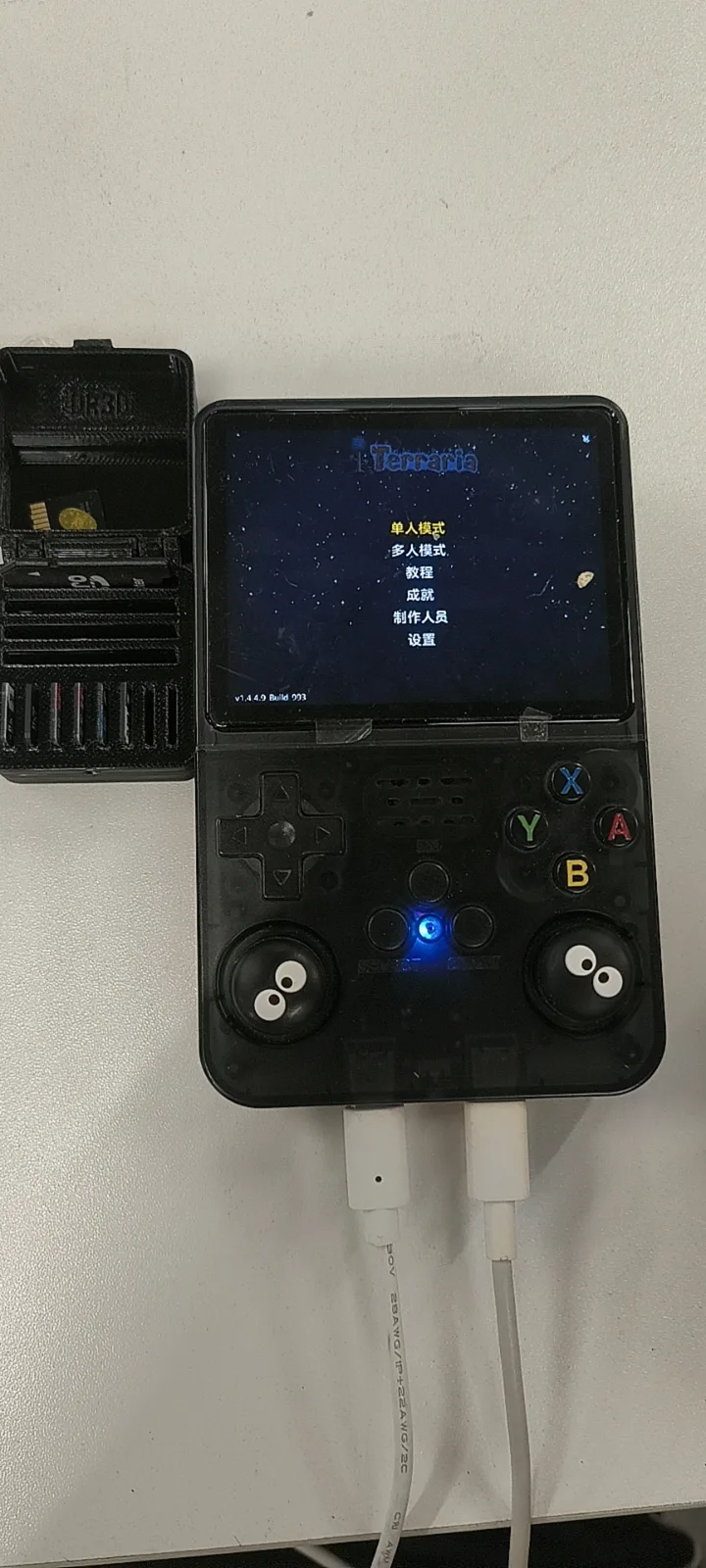
All quoted messages are translated by us from a corpus of public Chinese-language handheld groups — roughly 7,500 messages across nine groups with message bodies, from which 22,869 unique messages were scanned for keyword hits. It carries no usable time range and no speaker attribution, so we quote the group and never the person, and nothing in it is treated as a measurement of how common anything is. The tier boundaries are our reading of this chip class — a four-core Cortex-A35-class chip with a Mali-G31-class GPU — together with those owner reports; they are not benchmarks, and we publish no frame rates. The line about a dedicated machine being specially optimised while a handheld in this class is at best a pile of bundled emulators is an owner’s phrasing, quoted as theirs. The three-layer breakdown of why a game fails follows from how emulation works, not from tests we ran. The statement about which systems this machine is for, and the boundary above PlayStation 1, is the position already published on our own buying page; this page sorts the bands and explains the reason, and does not change that position. The photograph is a real photograph, cropped and downscaled only, of an owner’s unit showing a game the owner installed — no game ships with a handheld from this shop, and none of the diagrams on this page were generated by an image model.
Related reading
V12, V21 or V30 — and who should not buy one — the buying side of the same line, including the long list of reasons not to buy.
ArkOS, ROCKNIX or the system it came with — which build you are on decides which emulators are installed, which is layer one.
The games are on the card, but nothing shows up — when the problem is the front-end rather than the capability.
“I change a setting and it goes back.” — the fourth problem, which is not a capability question at all.
First steps — what to do in the first hour with a bare unit.